


What can turn a carefully planned international flight into a coordination challenge? A permit request based on incomplete trip details, unclear route requirements, or updates that do not reach everyone involved. Effective private jet permit filing involves more than submitting forms. Operators need to identify the overflight and landing requirements that may apply, prepare accurate supporting information, and track each request as the itinerary develops.
Requirements can differ by route and by whether a flight is a commercial charter or a private, non-revenue operation. Changes to the aircraft, schedule, or route may also affect coordination. If you are unsure what each jurisdiction requires or who should manage the process, start by confirming the trip details and the responsibilities of everyone involved.
This checklist explains how to prepare a complete, reviewable permit request and keep track of its status. It also covers the responsibilities involved in filing in-house or working with specialist support, including how permit coordination can align with flight planning. The aim is a repeatable process that helps prevent avoidable gaps while leaving room to adapt when plans change.
Key Takeaways
- Use a repeatable private jet permit filing checklist to move from route review to submission and status monitoring.
- Distinguish overflight from landing requests, then verify which requirements apply to each planned route.
- Agree which trip details your team must supply and which tasks a filing coordinator may research or arrange.
- Compare in-house filing and specialist support based on staff capacity, route familiarity, trip complexity, and responsibility for status updates.
- Set out how itinerary changes will be shared, who will manage follow-up, and what remains the operator’s responsibility.
Private Jet Permit Filing: What Operators Need to Prepare
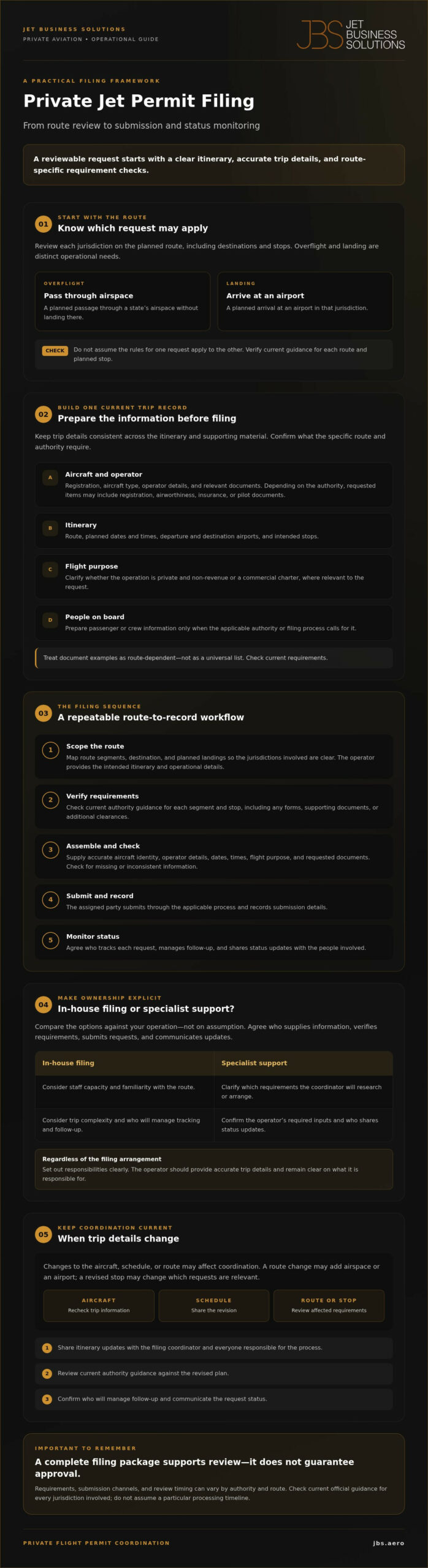
Private jet permit filing is the preparation and coordination of requests that may be required for a planned flight through or into a jurisdiction. Start with a defined itinerary and accurate aircraft and operator information, then check which requests and supporting documents apply. Private operations can differ from commercial flights, so clarify the flight’s purpose and operating status instead of assuming the same filing approach fits every mission. For broader context, the overview of private aviation describes how this sector differs from scheduled commercial air transport.
A complete submission gives the relevant parties a clear basis for reviewing and coordinating a request, but it does not guarantee approval. Requirements, submission channels, and review timing can vary by authority and route. Check current official guidance for every jurisdiction involved. For short-notice trips, confirming the route and assembling reliable details early can help reduce avoidable follow-up, but do not assume a particular processing timeline.
Which trip details should be ready before filing?
Build one current trip record before sharing information with an authority or filing coordinator. Confirm the requirements for the specific route, then organize the core details:
- Aircraft and operator: Registration, aircraft type, operator details, and relevant documents. Authorities may request items such as registration, airworthiness, insurance, or pilot documents. Verify current requirements rather than treating this as a universal list.
- Itinerary: Route, planned dates and times, departure and destination airports, and intended stops. Check that these details are consistent across the itinerary and supporting material.
- Flight purpose: Identify whether the operation is private and non-revenue or a commercial charter, where relevant to the request.
- People on board: Prepare passenger or crew information only when the applicable authority or filing process calls for it.
Assign someone to check that the information is complete and consistent before it is passed on. If a specialist coordinator is involved, agree which inputs the operator must provide and which route-specific requirements the coordinator will verify or arrange.
How do overflight and landing requests differ?
An overflight request relates to a planned passage through a state’s airspace without landing there. A landing request relates to an intended arrival at an airport in that jurisdiction. These are different operational needs, so do not assume the rules for one apply to the other.
Review each country on the planned route, including destinations and stops. A route change may add another airspace or airport, while a revised stop may change which requests are relevant. Check current authority guidance whenever the itinerary changes, and keep the filing coordinator informed so the request can be reviewed against the revised plan.
The Private Jet Permit Filing Checklist, from Route Review to Submission
A step-by-step workflow helps keep a request reviewable as trip details move between the operator, filing coordinator, and relevant authorities. Treat each jurisdiction as a separate verification point. Requirements and processes can vary, so confirm current rules for each trip instead of relying on an old checklist.
A complete filing package contains current, consistent trip data and the supporting documents required for the specific jurisdictions involved.
Move through the filing in sequence
- Scope the route. Map each route segment, destination, and planned landing so the jurisdictions involved are clear. The operator should provide the intended itinerary and operational details.
- Verify requirements. Check current authority guidance for each segment and planned stop, including whether forms, supporting documents, or additional clearances apply. A filing coordinator may research requirements, but information should be verified for the specific trip.
- Assemble the data. The operator supplies accurate aircraft identity, operator details, dates, times, flight purpose, and requested documents. Depending on the agreed responsibilities, the coordinator can organize the package and identify missing information.
- Submit and record. The assigned party sends the request through the applicable process, then records the submission details and any reference information received.
- Monitor and follow up. Track responses, questions, and outstanding actions until the status is clear. Keep the operator informed and respond promptly to requests for additional information.
What should operators verify before submitting?
Run a final consistency check across the itinerary and supporting documents. Confirm that aircraft identity and operator details match, compare routes, airports, dates, and times, and check that every planned landing and route segment has been reviewed against current authority requirements. Requirements can change, so note when and where jurisdiction-specific instructions were checked. Confirm them again if the trip changes before filing.
Clarify ownership before submission. Operators should provide accurate source information and respond to requests for missing details. A filing coordinator may research jurisdictional requirements, organize documents, and coordinate submission when those tasks are within the agreed scope. Confirm who handles each step rather than assuming responsibility has transferred.
What should happen after a request is submitted?
Maintain a simple status record for each request. Include its submission status, reference details, responsible contact, open questions, responses, and next actions. An acknowledgement confirms receipt, not approval. Keep tracking the request until the outcome or any further requirements are confirmed.
If dates, routing, aircraft, or operational details change, compare the revised itinerary with every submitted request and promptly notify whoever manages the filing. For operators coordinating across multiple jurisdictions, discussing permit filing requirements with Jet Business Solutions can help clarify how permit coordination may fit alongside flight planning.
In-House Filing or Permit Support: How to Compare the Options
The right approach depends on more than the number of permits involved. Compare your team’s available capacity, familiarity with the route’s jurisdictions, itinerary complexity, and ability to manage follow-up from submission through response. In-house filing may work when staff have the right expertise, access to current requirements, and enough time to manage the process alongside other duties. External coordination may help when a route spans multiple jurisdictions, internal capacity is limited, or trip details are changing.
| Factor | In-house filing | External permit support |
|---|---|---|
| Staff capacity | Assess whether assigned staff can handle preparation, follow-up, and changes alongside their other responsibilities. | Clarify which coordination tasks the provider takes on and what remains with your team. |
| Jurisdictional familiarity | Confirm staff can verify current requirements for every jurisdiction on the planned route. | Ask about relevant geographic scope and how route-specific requirements are checked. |
| Trip complexity | Consider whether the team can manage the route, stops, and revised details consistently. | Consider support if multiple jurisdictions or itinerary changes add coordination work. |
| Status ownership | Assign a clear owner for records, open questions, authority responses, and operator updates. | Agree who tracks each request, communicates updates, and follows up on missing information. |
When can an operator manage filings internally?
In-house private jet permit filing may suit a team that can verify current requirements across the route, maintain accurate application records, and follow up on open questions. Consider workload as well as expertise. If several requests need attention at once, filing tasks may compete with dispatch duties. Assign a named owner and backup, and decide how status will be recorded and shared.
What should a permit-support provider clarify?
Before engaging a provider, ask which filing tasks it handles, which documents and trip details your team must supply, and how it reports status or requests missing information. Agree how itinerary changes will be communicated and who will act on them. Check that the provider’s geographic scope fits the planned route, and verify current coverage and intake requirements rather than assuming universal availability.
Make the decision based on operational ownership, not an assumption of guaranteed approval or fixed processing times. A specialist coordinator such as Jet Business Solutions may be an option for operators managing multiple jurisdictions or evolving trip details. Clarify responsibilities and scope before relying on external support.
Avoid Filing Gaps When Private Jet Trip Details Change
Permit coordination can fall out of step with the operation when trip details change after a request is prepared or submitted. Revised routing, schedule adjustments, an aircraft change, or a new planned stop may affect information already shared. The key is to assess each change promptly. Do not assume every amendment requires a new submission, or that an earlier request still reflects the current plan.
Use a simple change-control sequence:
- Log the change. Record what changed, when it changed, and which flight segments are affected.
- Assess affected requests. Ask the filing lead to review whether the change affects a submitted request, supporting documents, or related coordination.
- Communicate promptly. Send revised details to the person managing the filing and identify any time-sensitive points.
- Confirm status. Record the response and next steps. If it is unclear whether an authority requires an update or new filing, confirm through the appropriate channel.
What should operators do when the itinerary changes?
Notify the filing lead with the revised details and affected route segments, rather than forwarding a changed itinerary without explanation. Specify whether the departure time, aircraft details, or planned stop has changed. Ask whether existing requests or documents need attention, then update the trip record so operators and coordinators are working from the same version. Do not treat previously submitted information as current until its status has been checked.
Which warning signs call for escalation?
Escalate unresolved authority questions, conflicting details across documents, or a submission whose current status cannot be confirmed. The need for clarity becomes more pressing as planned departure approaches and required confirmations remain outstanding. Identify the issue, the responsible contact, and the next action, then keep the operator informed. Permit coordinators can support filing coordination, but operational decisions remain with the operator and responsible flight crew.
Clear communication helps preserve flexibility without assuming a particular authority response or outcome. If an itinerary is changing across several jurisdictions, discuss permit coordination for your trip with Jet Business Solutions and clarify how updates and filing responsibilities will be managed.
Choose a Private Jet Permit Filing Partner with Clear Operational Ownership
A productive working relationship starts with a shared understanding of scope. Before appointing a provider, establish which parts of private jet permit filing it will coordinate, what information your team must supply, and who will manage communication from initial review through status updates. Clear responsibilities help prevent missing inputs and unanswered questions, especially when the itinerary is still developing.
What questions help evaluate a filing provider?
Ask how the provider checks current requirements for each jurisdiction on your itinerary and how it will flag details that still need confirmation. Then clarify the working process:
- Geographic scope: Can the provider support the jurisdictions on this route, and how can you confirm coverage for this specific trip?
- Required inputs: Which aircraft, operator, itinerary, and supporting details must your team supply, and how will incomplete information be identified?
- Status updates: Who will provide updates, through which contact, and how will open questions or authority responses be tracked?
- Changes: How should revised routing, timing, aircraft details, or stops be reported, and who will assess their effect on active requests?
Ask for a plain-language explanation of what the service includes and what remains outside its scope. Avoid assumptions about approval, processing times, or universal coverage. Confirm who contacts the operator when more information is needed and who checks that revised trip details reach the filing lead.
How can operators prepare for a support discussion?
Bring a draft itinerary, aircraft and operator details, the intended flight purpose, and any known operational constraints. Identify the required departure window, along with routing or stop options that remain undecided. Sharing what is confirmed and what may change gives the provider a clearer basis for discussing filing requirements without treating provisional information as final.
Jet Business Solutions coordinates flight permits, including overflight and landing permit arrangements, alongside flight planning. Operators can discuss an itinerary and clarify the scope of support, required inputs, and task ownership before proceeding. The conversation should establish a practical division of responsibilities, not an assumed approval outcome.
For itinerary-specific requirements, discuss permit and flight-planning support with Jet Business Solutions.
Put a Clear Permit Process in Place for Your Next Flight
Reliable private jet permit filing starts with clear responsibilities and trip information that stays aligned as plans develop. A repeatable process helps your team identify route-specific requirements, track each request, and respond methodically when details change. The choice between in-house and specialist support depends on your team’s expertise, capacity, and ability to manage status and follow-up.
Jet Business Solutions arranges overflight and landing permits across international jurisdictions, with flight planning and dispatch support available alongside permit coordination. This can help connect filing tasks with the wider trip plan, while approval remains subject to the relevant authorities.
To discuss your itinerary, route, and filing requirements, contact Jet Business Solutions about your private jet permit filing requirements. Clear ownership and well-coordinated information give your team a more organized basis for international planning.
Frequently Asked Questions
What information is needed for private jet permit filing?
Private jet permit filing typically starts with the aircraft registration and type, operator details, flight purpose, and a complete itinerary with dates, times, airports, and planned stops. Authorities may also require supporting documents or passenger and crew details, depending on the route and operation. Confirm current requirements for each jurisdiction, then check that details match across forms and documents before submission.
How far in advance should a private jet permit be filed?
There is no single lead time that applies to every permit. Requirements and review timing vary by authority, route, and request type. Short-notice filing may leave less time to address questions or provide missing information. Check current authority guidance as soon as the itinerary takes shape, and ask the filing coordinator to identify any known timing considerations for the jurisdictions involved. Do not treat an estimated timeline as approval.
Do private jets need both overflight and landing permits?
Not necessarily. An overflight request concerns passage through a jurisdiction’s airspace, while a landing request relates to an intended arrival there. Whether either is required depends on the route, operation, and applicable local requirements. A flight that crosses one jurisdiction and lands in another may involve different checks for each. Verify current requirements for every route segment and planned stop rather than assuming one permit covers the entire trip.
Can a flight-support provider guarantee permit approval?
No provider should promise an authority’s approval. A flight-support provider may coordinate permit requests, organize trip information, and communicate about application status, but the relevant authority determines the outcome. Before engaging support, clarify which tasks the provider handles, how it will flag missing information, and how updates will be shared. Confirm jurisdiction-specific requirements through current guidance, and do not treat submission or acknowledgement as authorization.
What happens if the aircraft itinerary changes after filing?
Tell the person managing the filing promptly and identify the affected flight segments. A revised route, schedule, aircraft, or stop may affect existing requests or supporting information, but do not assume every change requires resubmission. Ask the filing lead to check with the relevant authority where needed, then record the revised status and next actions. Keep the operator and responsible flight crew informed so decisions reflect confirmed information.
Is it better to file private jet permits in-house or use a service?
It depends on your team’s expertise, available capacity, and familiarity with current requirements across the planned route. In-house filing may suit operators able to manage research, records, follow-up, and itinerary updates without disrupting other duties. Specialist support may help coordinate requests across several jurisdictions or when internal resources are limited. Compare responsibilities and scope carefully. External support does not guarantee approval or a particular processing time.
How can I check the status of a private jet permit request?
Start with the person or provider responsible for filing and ask for the latest status, submission reference if available, outstanding questions, and next follow-up action. Keep a record for each request so it is clear which jurisdiction it concerns and who owns the next step. An acknowledgement may confirm receipt, not approval. If the status is unclear, ask the filing contact to verify it through the applicable authority channel.