


What makes a fuel stop dependable is often decided before the aircraft reaches the airport. Aviation fueling involves more than finding a supplier: procurement terms, local service arrangements, and timely coordination all affect whether an uplift fits the operation. Fuel availability and procedures can vary by airport and jurisdiction, so assumptions can complicate planning and turnaround control.
A clear request, confirmed arrangements, and an uplift coordinated with the flight schedule give operators a stronger basis for planning. In practice, details matter: unclear terms make costs harder to assess, while incomplete coordination can put pressure on a scheduled stop. A consistent process helps identify what to confirm, who is responsible, and when to follow up.
This guide covers the steps from fuel request to completed uplift, and compares procurement and into-plane service arrangements using practical criteria. It also explains how to coordinate fueling with flight planning, permits, handling, and turnaround requirements so you can prepare a more informed plan for each stop.
Key Takeaways
- Distinguish fuel supply, procurement, and into-plane fueling to identify which arrangements your trip requires.
- Use a consistent sequence for requests and confirmations. Provide accurate airport, aircraft, quantity, and schedule details.
- Compare local supply, contract fuel, and supported procurement by their terms, coordination scope, and operational effort. Don’t assume one option suits every trip.
- Use a staged aviation fueling checklist to manage pre-trip requests, schedule updates, and post-uplift review.
- Evaluate potential partners for geographic reach, clear communication, transparent terms, and how fueling coordination fits with permits, flight planning, and handling.
Aviation Fueling Explained: From Fuel Request to Aircraft Uplift
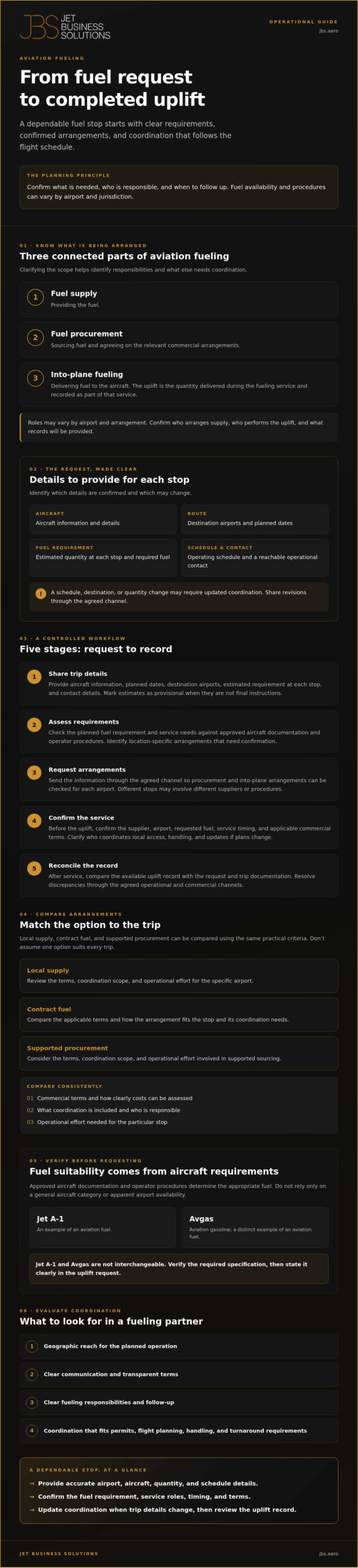
Aviation fueling is the coordinated process of procuring, arranging, and delivering appropriate fuel to an aircraft. The term covers connected but distinct activities: fuel supply means providing the fuel, fuel procurement is sourcing it and agreeing on the relevant commercial arrangements, and into-plane fueling is delivering fuel to the aircraft. Identifying which part is being arranged helps operators clarify responsibilities and confirm what else needs coordination.
An uplift is the quantity of fuel delivered to an aircraft during a fueling service, recorded as part of that service. The requested and delivered amounts should follow the operator’s instructions and applicable aircraft procedures. For a general overview of fuel categories, see Aviation fuel.
What does into-plane fueling include?
Into-plane fueling connects the operator’s request with the supplier and the personnel carrying out the service. Depending on the airport and arrangement, an airport or fixed-base operator (FBO) may also coordinate access, timing, or service details. Roles and procedures vary, so confirm them for each stop rather than assume a standard process.
In practice, the request is reviewed, the service is coordinated for the planned stop, and the uplift is carried out and recorded. Include the airport, aircraft, requested quantity, and schedule in the request. A change to the schedule or quantity may require updated coordination. Confirm who is arranging the supply, who is performing the uplift, and what records will be provided. This makes responsibilities clear from request through completion.
Which fuel does an aircraft need?
The aircraft’s approved documentation and the operator’s procedures determine the appropriate fuel. Don’t choose a fuel type based only on the aircraft’s general category or on what appears to be available at an airport. Verify the requirement using authoritative aircraft information, then confirm that the requested fuel can be arranged at the planned stop.
Jet A-1 and aviation gasoline, commonly called Avgas, are distinct examples of aviation fuels, not interchangeable options. Which is relevant depends on the specific aircraft and its approved operating procedures. Fuel names alone don’t establish compatibility. Confirm the required specification through the appropriate aircraft documentation and operator processes, then state it clearly when requesting an uplift.
How Aviation Fueling Works: Procurement, Coordination, and Uplift
A controlled aviation fueling workflow turns a trip plan into a specific request, a confirmed service, and a record that can be reviewed afterward. Each stage relies on accurate information. The airport determines which local arrangements may apply, while the aircraft, requested quantity, and operating schedule shape what needs to be coordinated.
For an accurate fuel request, provide the aircraft details, operating dates, destination airports, estimated fuel requirement, schedule, and a reachable operational contact. Identify which details are confirmed and which may change.
- Share trip details. Provide the aircraft information, planned dates, destination airports, estimated requirement at each stop, and contact details. Mark estimates as provisional rather than presenting them as final instructions.
- Assess requirements. Review the planned fuel requirement and service needs against the aircraft’s approved documentation and operator procedures. Consider the schedule and any location-specific arrangements that need confirmation.
- Request arrangements. Send the information through the agreed channel so procurement and into-plane arrangements can be checked for each airport. A multi-leg route may involve different suppliers or procedures at different stops.
- Confirm the service. Before the uplift, confirm the supplier, airport, requested fuel, service timing, and applicable commercial terms. Clarify who coordinates local access, handling, and updates if plans change.
- Reconcile the record. After the service, compare the available uplift record with the request and trip documentation. Resolve discrepancies through the agreed operational and commercial channels.
Timing and location both matter. Changing the destination airport can affect which supplier or local contact needs to be involved. A revised schedule or quantity may mean the request needs updating. Communicate route or timing changes promptly through the agreed channel, and distinguish confirmed details from estimates that are still subject to change.
Coordinate fueling with the wider flight plan
Fuel arrangements are one part of a connected flight-support workflow. Aligning the request with flight planning, permits, and ground handling helps keep relevant teams informed of the route and schedule. These remain distinct activities, so clarify responsibilities rather than assuming confirmation of one arrangement confirms the others.
Jet Business Solutions arranges fuel procurement and into-plane fueling, with related support that includes permits, flight planning, and ground handling. Operators can share trip details to support coordination, then confirm current airport coverage, supplier availability, and service terms for their itinerary. Learn more about aviation fueling coordination as part of planning a trip.
Aviation Fueling Options Compared: Local Supply, Contract Fuel, and Coordination
No single procurement model suits every itinerary. The right choice depends on how often you operate a route, how many stops need coordination, and how much operational effort your team can manage. Compare arrangements by their actual scope and terms, not by assuming one option is always cheaper or more dependable. Availability, service details, and commercial terms can vary by airport, supplier, and agreement.
The options below are broad models. Contract provisions differ, and supported procurement can vary in scope. Before committing, ask what is included at each stop, how the commercial terms are documented, and who is responsible for communicating changes.
| Option | Coordination scope | Commercial terms to verify | Operational effort | Potential trip fit |
|---|---|---|---|---|
| Direct local arrangement | The operator coordinates with a local supplier for the planned airport. | Confirm the applicable terms, payment process, and service documentation directly. | The operator manages contacts and updates for each location. | A straightforward trip where the operator already has a suitable supplier relationship. |
| Contract fuel arrangement | Service is arranged under an applicable contract or pricing agreement. | Review covered locations, pricing basis, payment terms, and any conditions in the agreement. | Effort depends on the contract’s scope and how requests or changes are handled. | Recurring routes or operations where it may be useful to assess agreed terms across planned stops. |
| Supported procurement | A support provider helps coordinate procurement and into-plane arrangements, subject to the agreed scope. | Clarify how terms are confirmed, what documentation is provided, and which services are included. | Some coordination may be handled externally, but responsibilities still need to be explicit. | Multi-stop or international trips where the operator wants to assess coordinated support. |
When might local supplier coordination be sufficient?
A direct local arrangement may suit a simple trip when the operator knows the supplier and can manage the request, confirmation, and any updates. Consider route complexity and trip frequency as well as familiarity. Knowing a contact at one airport doesn’t establish availability or service details at another. Confirm the specific airport, operating schedule, requested fuel, and applicable terms for each trip.
When can contract fuel or coordinated support help?
For recurring routes or itineraries with several stops, compare contract fuel and supported procurement with separate local arrangements. Review who handles requests, how commercial terms are presented, and who communicates schedule changes. Coordinated support may change the division of work, but it does not establish savings or availability. Jet Business Solutions arranges jet fuel procurement, into-plane fueling, and contract fuel pricing for corporate operators and charter flights. Confirm current airport coverage and terms for your itinerary. Review global aviation fueling support as one option to evaluate.
A Practical Aviation Fueling Checklist for International and Multi-Leg Flights
A multi-stop itinerary can involve different suppliers, operating schedules, service arrangements, and commercial terms. Treat each airport as a separate confirmation point while keeping the full route and schedule visible to the people coordinating the trip. Use this checklist to track open items without assuming fuel or an alternative arrangement will be available.
Pre-trip request
- List each planned airport and operating date, aircraft details, estimated fuel requirement, and supplier or coordination contact.
- Identify the responsible coordinator and distinguish confirmed trip details from estimates that may change.
- Record the requested service scope and applicable commercial terms for each stop. Note outstanding confirmations and who will resolve them.
Pre-departure confirmation
Before departure, verify the airport, supplier, requested fuel, operating schedule, service timing, and agreed terms at each planned stop. Confirm who will coordinate local handling, access, and operational updates. Check how fuel arrangements align with the wider plan, including relevant permits, flight planning, and ground handling. If a detail remains unconfirmed, identify the responsible contact and next step rather than treating it as settled.
Consider contingency arrangements for each stop, but verify them with the relevant contact. Treat an alternative airport or supplier as an option to assess, not as confirmed supply.
En-route updates
Changes can affect more than the uplift request. A revised route may change the airport or supplier. A timing adjustment can affect coordination at the location, while an aircraft or quantity change may require the request to be reviewed. If a trip changes, reconfirm the airport, operating date and time, aircraft, requested quantity, supplier, service scope, and applicable terms with the responsible coordinator. Send updates promptly through the agreed channel and make clear which details have changed.
Keep a current record of confirmations and open items across the itinerary. This gives the operator and relevant contacts a shared reference when plans shift, without assuming an earlier confirmation applies to a revised trip.
Post-uplift review
After each service, compare the uplift documentation with the request and the operator’s trip records. Check the airport, aircraft, service details, recorded quantity, and available commercial documentation. Raise discrepancies through the agreed channel while the trip information is accessible. Tankering involves separate operational considerations. Consult a dedicated article on that subject when available rather than treating it as part of this checklist.
For help coordinating aviation fueling alongside related trip requirements, submit your trip details to Jet Business Solutions for review.
Choosing an Aviation Fueling Partner for Reliable Global Operations
Evaluate a provider by how clearly it defines its role, communicates changes, and documents arrangements, not by broad claims of reach alone. For aviation fueling across an international route, confirm what can be coordinated at each planned location and what remains the operator’s responsibility. Coverage, supplier availability, and service terms may differ by airport, so request location-specific confirmation.
Questions to ask before selecting a fueling support provider
- Geographic reach: Which planned airports can the provider support, and how is supplier confirmation obtained for each location?
- Communication: Who is the operational contact for schedule or routing changes, and how should updates be sent?
- Scope and timing: What does the arrangement include, who coordinates the service at the airport, and how is uplift timing confirmed?
- Commercial transparency: Which terms apply at each stop, and how are they communicated and documented? Clarify who handles questions or discrepancies.
- Service records: What documentation is provided after the uplift, and how can the operator check it against the request?
Ask for confirmation by location rather than assuming that a provider’s general reach means uniform coverage or availability. Clear answers help identify open items before departure and establish who is responsible for resolving them.
How coordinated support can fit the wider trip
Fuel procurement is one element of flight support. Coordinating it with flight planning, permits, and ground handling can help relevant teams work from the same route and schedule information. These services remain distinct, so confirm each scope separately and establish how itinerary updates will be shared.
Jet Business Solutions arranges global fuel procurement and into-plane fueling, including contract fuel pricing for corporate operators and charter flights. Related flight support includes permits, flight planning, and ground handling. Provide your route and operational requirements, then verify current airport coverage, supplier availability, and service terms for each stop. This gives both sides a clear basis for discussing what can be arranged without presuming a particular outcome.
To discuss your route and operational requirements, contact Jet Business Solutions about global fueling arrangements.
Put a More Controlled Fueling Plan in Motion
A well-coordinated fueling plan starts with clear responsibilities and confirmation for each location. Treat procurement, service coordination, and the uplift as connected but distinct steps, and keep trip details current when routing or timing changes. Comparing local arrangements, contract terms, and supported procurement against your operation’s needs helps you choose an approach that fits the route rather than relying on assumptions.
For international and multi-leg trips, align fuel arrangements with flight permits, flight planning, and ground handling while confirming each service’s scope separately. Review the completed uplift record against the request and trip documentation to maintain a clear operational trail.
Jet Business Solutions arranges global jet fuel procurement and into-plane fueling, with related support that includes permits, flight planning, and ground handling. Share your route and operational requirements to discuss what may be arranged and what needs confirmation at each stop. Discuss your global aviation fueling requirements and take the next step toward a better-coordinated operation.
Frequently Asked Questions
What is aviation fueling?
Aviation fueling is the coordinated procurement and delivery of appropriate fuel to an aircraft. The process may involve identifying a supplier, confirming airport service arrangements, coordinating the uplift, and reviewing service records. The steps depend on the aircraft, operator procedures, airport, supplier, and trip requirements. Verify fuel compatibility against authoritative aircraft documentation and the operator’s approved procedures. Don’t infer it from aircraft category or fuel availability alone.
How does into-plane fueling work?
Into-plane fueling is the delivery of fuel to an aircraft at its operating location. The operator or its support partner coordinates the request with the relevant supplier and airport-side contacts, confirms requirements and timing, and communicates changes that may affect service. After the uplift, the operator checks the service record against the original request and its operational documentation. Local procedures and responsibilities can vary by airport.
How much does aviation fuel cost?
Aviation fuel pricing varies according to fuel type, location, supplier, timing, commercial arrangement, and included services. For a meaningful comparison, ask for current, location-specific terms and clarify the quoted unit, applicable fees, payment conditions, and whether procurement coordination or into-plane service is included. Don’t compare headline figures until you understand their scope. Confirm applicable terms directly with the supplier or fueling support provider before planning around them.
What information is needed to arrange aviation fueling?
A fueling request generally needs aircraft and operator details, the planned airport and operating date, expected timing, requested fuel type and quantity, and a reliable operational contact. Identify which trip details are confirmed and which are estimates. If the route or schedule changes, send updated information through the agreed communication channel. Confirm any additional airport requirements with the supplier, and validate fuel requirements using approved aircraft documentation.
Can aviation fueling be arranged internationally?
Yes, aviation fueling can be coordinated for international itineraries, but airport coverage, supplier availability, commercial terms, and local procedures vary by location. Confirm arrangements separately for every planned stop rather than assuming one agreement applies across the route. Share the itinerary and schedule with the relevant supplier or support partner, establish who will communicate updates, and verify service details for each airport before relying on the arrangement.
What is the difference between local fuel purchasing and contract fuel?
Local purchasing generally means arranging fuel directly with a supplier at a particular location. Contract fuel uses an agreement that sets commercial or service terms, although scope and terminology can differ between providers. Compare covered locations, responsibilities, payment terms, request and confirmation processes, and the records provided. The most suitable approach depends on route frequency, the operator’s capacity to manage coordination, and the terms actually offered.
What should operators check after an aircraft fuel uplift?
After an uplift, compare the service documentation with the request, including the aircraft, location, date, requested fuel, and recorded quantity. Reconcile available records with internal trip and accounting documentation, and raise any discrepancy through the agreed supplier or support channel. Keep relevant changes and approvals in line with operator procedures. Documentation formats and requirements can vary, so confirm what records will be provided before the service.
Does aviation fueling support include flight permits and ground handling?
Not necessarily. Fueling and broader flight-support services are distinct, so ask whether permits, flight planning, or ground handling are included in the provider’s scope and who is responsible for each arrangement. Jet Business Solutions arranges global fuel procurement and into-plane fueling, with related support that includes flight permits, flight planning, and ground handling. Confirm the specific services, airport coverage, supplier availability, and terms needed for your itinerary.